

Optimal Cleaning Schedule for Solar Arrays in TX & OK
Solar O&M, Commercial & Industrial Energy, Texas & Oklahoma
How Often Should Commercial Solar Arrays Be Cleaned in Texas and Oklahoma?
In the Southern Plains, dust, drought, and agriculture can quietly erode the performance of commercial and industrial solar assets. For businesses and public agencies in Texas and Oklahoma, getting the cleaning schedule right is a direct lever on ROI, production forecasts, and contract compliance.
Baseline: How Often Do C&I Arrays Need Professional Cleaning?
Industry guidance for temperate, relatively clean environments is one to two professional cleanings per year for commercial and industrial solar arrays, assuming periodic rainfall helps rinse surfaces (SolarReviews; EnergySage). In Texas and Oklahoma, that baseline is usually too conservative.
Across the region, a practical rule of thumb for business and agency portfolios is:
Quarterly cleaning (3–4 times per year) for most ground‑mount and flat‑roof systems.
Bi‑monthly or monthly cleaning for arrays near heavy agriculture, unpaved yards, or industrial dust sources.
National Renewable Energy Laboratory (NREL) work on soiling shows that losses can reach several percent in just a few weeks under dusty conditions, making more frequent cleaning economically justified for high‑value C&I systems (NREL, Understanding Soiling Losses).
Dust Storms: Short Events, Big Soiling Spikes
Dust storms in Texas and Oklahoma can deposit a dense film of fine particles in a matter of hours. Studies show dust events can trigger double‑digit production losses until panels are washed, especially when followed by dry, calm weather (SolarReviews; ScienceDirect on dust storms).
Operational impact: Reduced irradiance on the glass surface, higher mismatch losses, and potential micro‑abrasions if dust is not removed with appropriate methods.
O&M response: Many asset managers in the region schedule event‑based cleanings—triggering a service visit when monitoring data shows a sudden, unexplained drop in output after a storm.
💡 Pro Tip for Facilities Teams: Pair SCADA or monitoring alerts with local weather feeds so dust‑storm events automatically flag arrays for inspection and potential cleaning.
Drought: When Rain Can’t Do the Rinsing
Drought doesn’t just dry out landscapes; it also removes nature’s free cleaning service. Without periodic rain, dust, pollen, and organic debris accumulate steadily. Research on solar maintenance notes that in dry climates, cleaning frequency needs to increase to offset the absence of rainfall rinses (EnergySage; Clean Energy Reviews).
Expect higher soiling rates during prolonged droughts, especially on low‑tilt commercial roofs where particles do not slide off easily.
Many owners shift from semi‑annual to quarterly or bi‑monthly cleaning during drought periods to keep performance within PPA or budgeted production ranges.
Agricultural Activity: Invisible Dust, Visible Losses
For arrays near cropland, feedlots, or unpaved logistics yards, agricultural soiling can dominate the loss profile. Tilling, harvesting, livestock movement, and truck traffic all inject dust and organic particulates into the air. NREL and regional studies highlight that rural and peri‑urban arrays often experience higher and more variable soiling than purely urban sites (NREL; Texas soiling impact studies).
Dust and soil: Fine particles from fields can form a compacted layer that is difficult to dislodge without professional equipment.
Organic matter: Pollen, chaff, and manure aerosols can create sticky deposits that attract even more dust and may promote microbial growth.
For agricultural‑adjacent commercial arrays, it is common to budget for bi‑monthly or monthly cleanings during peak field activity, then relax to quarterly service in the off‑season.
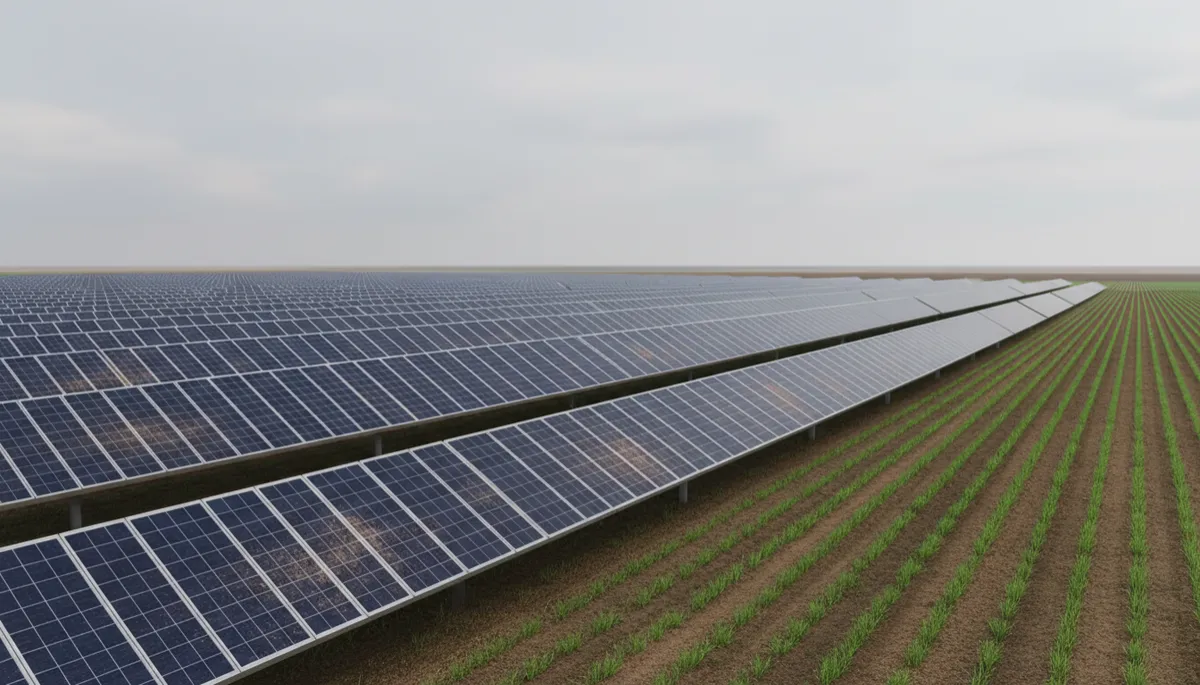
Arrays near active cropland often justify more frequent cleaning during tilling and harvest.
City‑by‑City: Soiling Patterns Across Key Markets
DFW (Dallas–Fort Worth)
The DFW metroplex combines construction dust, traffic emissions, and regional pollen. Soiling is typically moderate but persistent, with spikes during windy, dry periods. For large commercial roofs and industrial parks, a quarterly cleaning schedule plus event‑based visits after major dust storms is a solid baseline.
Austin
Austin is notorious for seasonal pollen, particularly in spring. Studies note that pollen can significantly increase short‑term soiling rates on PV surfaces in Central Texas (Texas soiling impact research). Many campus, municipal, and tech‑sector arrays adopt quarterly cleaning, with an extra visit during peak pollen season to protect production targets.
San Antonio
San Antonio shares Austin’s pollen challenges but often sees slightly dustier conditions and more nearby agriculture. Ground‑mount municipal and utility‑adjacent commercial sites on the outskirts may benefit from bi‑monthly cleaning in dry months, scaling back to quarterly when rainfall is more regular.
Houston
Houston’s frequent rain and high humidity mean that natural rinsing is more reliable. However, urban and industrial pollution can leave oily films that rain alone doesn’t remove. For most commercial and agency arrays, two to three professional cleanings per year are often sufficient, with extra attention for sites near refineries, ports, or heavy industry where airborne contaminants are higher.
Oklahoma City
Oklahoma City frequently experiences dustier, wind‑driven conditions than most Texas metros, and research on urban soiling notes meaningful dust contributions in similar cities (ScienceDirect, urban soiling). For C&I portfolios here—especially those near open land or industrial yards—bi‑monthly cleaning is often warranted, with monthly service for high‑value or heavily exposed assets.
Building a Data‑Driven Cleaning Strategy
While regional rules of thumb are useful, the most effective approach for businesses and agencies is data‑driven scheduling:
Track performance before and after cleanings to quantify your site‑specific soiling losses.
Integrate local weather and agricultural calendars (harvest, tilling, construction phases) into maintenance planning.
Align cleaning contracts with production guarantees in PPAs or internal performance benchmarks.
In practice, most commercial and industrial arrays in Texas and Oklahoma will land between three and six professional cleanings per year, with the higher end driven by dust storms, drought, and agricultural activity. Calibrating that schedule to each site’s environment is one of the simplest ways to protect yield, extend asset life, and deliver on the financial promises behind your solar investment. Not sure where your site falls on that range? Request a Site Assessment and we'll build a cleaning schedule matched to your exact location and array type.
